
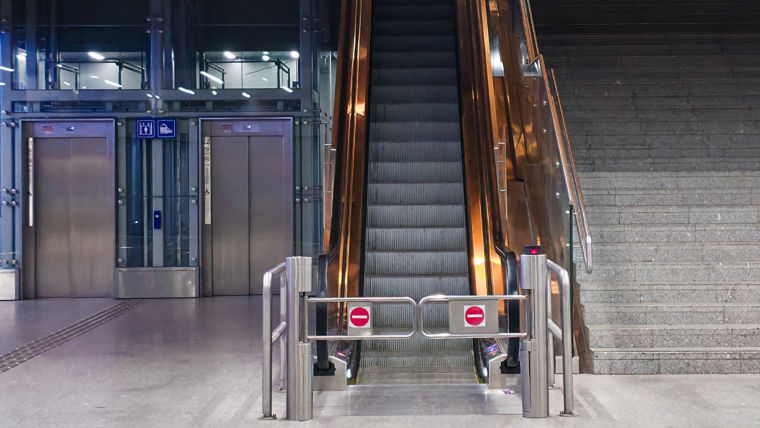
The short answer
A lift, or elevator, carries people vertically in an enclosed car that travels between fixed floors. You wait, you board, you arrive.
An escalator is a moving staircase on a fixed incline, usually around 30 degrees. It runs continuously, so nobody waits.
A travelator is a moving walkway. It runs flat or on a gentle slope, and it carries people horizontally across distance rather than up through height.
Lift or elevator?
Worth clearing up early, because it trips people up in Australian projects. Lift and elevator mean the same thing. Australian and British usage favours lift, American usage favours elevator, and both appear in local specifications and product literature. If you see them used interchangeably in a tender document, nothing different is being described. Our KONE glossary of terms sets out the rest of the vocabulary the industry uses without explaining.
Elevator vs escalator
The instinct is to compare these on speed. That is the wrong axis.
A lift moves a defined group of people a long vertical distance, efficiently, with a wait at either end. An escalator moves a continuous stream of people a short vertical distance with no wait at all. Over ten storeys, the lift wins comfortably. Over two, the escalator moves far more people per hour for the floor area it occupies, because there is no dwell time and no door cycle.
That is why you rarely see one replacing the other in practice. A shopping centre uses escalators between trading levels and lifts to the car park. A tower uses lifts as the core and escalators only across the podium. They are solving different problems in the same building, and the design question is almost never which one, but where each.
Capacity, travel height and dwell time are the numbers that decide it. Speed on its own tells you very little.
What is a travelator?
A travelator is a conveyor for people. Flat or gently inclined, it moves passengers horizontally along a route they would otherwise walk.
The name changes depending on who you ask. Travelator, moving walkway, moving walk and autowalk all describe the same equipment, and you will see the terms used interchangeably across specifications and manufacturer documentation. Some inclined versions are built to carry shopping trolleys or luggage trolleys safely, which is why they turn up in large-format retail and airports rather than offices.
The commercial case for one is rarely about speed. Walking pace does not change dramatically on a travelator. What changes is how long a distance feels, how evenly people spread along it, and whether they arrive at the other end willing to keep going. On a 200 metre concourse, that is the difference between a route people use and a route people avoid. Our TravelMaster 115 is built for exactly that job in commercial and transit settings, with the heavier-duty TransitMaster 165/185 covering demanding infrastructure environments.
Escalator vs travelator
Same underlying technology, different geometry, different purpose.
An escalator forms steps as it climbs and flattens them at each end. It exists to defeat height. A travelator keeps a continuous surface throughout, because it exists to defeat distance. A steeply inclined travelator is still a travelator, since the surface never breaks into steps, and that is what allows trolleys and wheeled luggage to ride safely.
The practical consequence is that you cannot substitute one for the other. If your problem is a level change, a travelator will need an impractical run to solve it. If your problem is a long horizontal walk, an escalator solves nothing at all.
The accessibility point that decides it
This is the part that gets missed most often, and it is not a preference. It is a design constraint.
Under Australian accessibility guidance, a continuous accessible path of travel cannot include a step, stairway, turnstile, revolving door, escalator or moving walkway. All of those are treated as impediments rather than as accessible routes.
The consequence is direct. Escalators and travelators can carry the bulk of your traffic, but they cannot form an accessible path. A building that relies on them still needs a lift, and that lift is not a supplementary convenience. It is the accessible route, and it needs to be located, sized and signposted as such rather than tucked behind a service corridor because the escalators are handling the volume.
Access provisions differ by building class and project, so confirm what applies to yours with your building surveyor or access consultant early. Retrofitting an accessible route after the circulation strategy is locked is expensive in a way that planning for it never is.
Which does your building need?
Offices and towers: Lifts as the core, escalators only where a podium or lower floors carry heavy two-way traffic.
Retail and shopping centres: Escalators between trading levels, because they move volume and keep shoppers flowing past stores. Lifts for the car park, for prams and trolleys, and for the accessible route.
Airports and transit: All three. Travelators along concourses, escalators between platform and concourse, lifts for accessibility and for anyone with heavy luggage.
Healthcare: Lifts dominate, sized for beds, trolleys and staff traffic. Escalators only in public areas, never on clinical routes.
Residential: Lifts, almost always. Escalators appear only where a development includes retail below.
You can see the full range across our lifts and elevators and escalators and moving walks pages.
Getting the mix right
Almost no building of any size runs on one of these alone. The useful question is not which machine wins, but how many of each, positioned where, sized for what pattern of movement across a day.
That is a modelling exercise rather than a shopping decision, and it is far cheaper to get right at concept stage than after the cores are drawn. If you are working through it now, talk to us early. The answer usually changes the floor plan.